Projects

Dreams painted on walls.

Community murals. Workshops, self-discovery groups.

Over the past ten years we have carried out many mental-health programmes and projects. In our work we have worked with children, adolescents, young adults, families, young people living with disabilities, adults with mobility impairments, the elderly and university students.

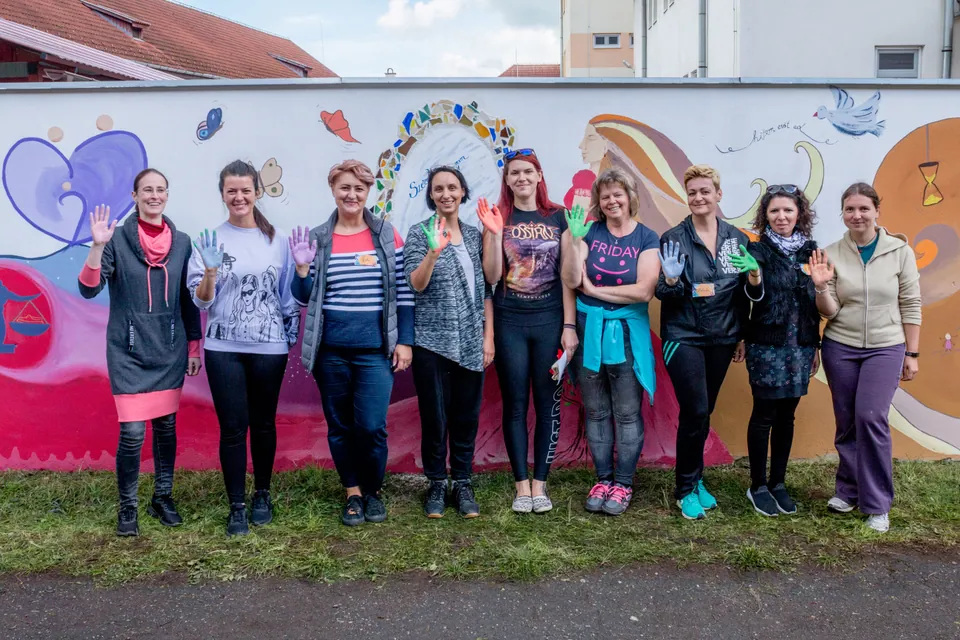
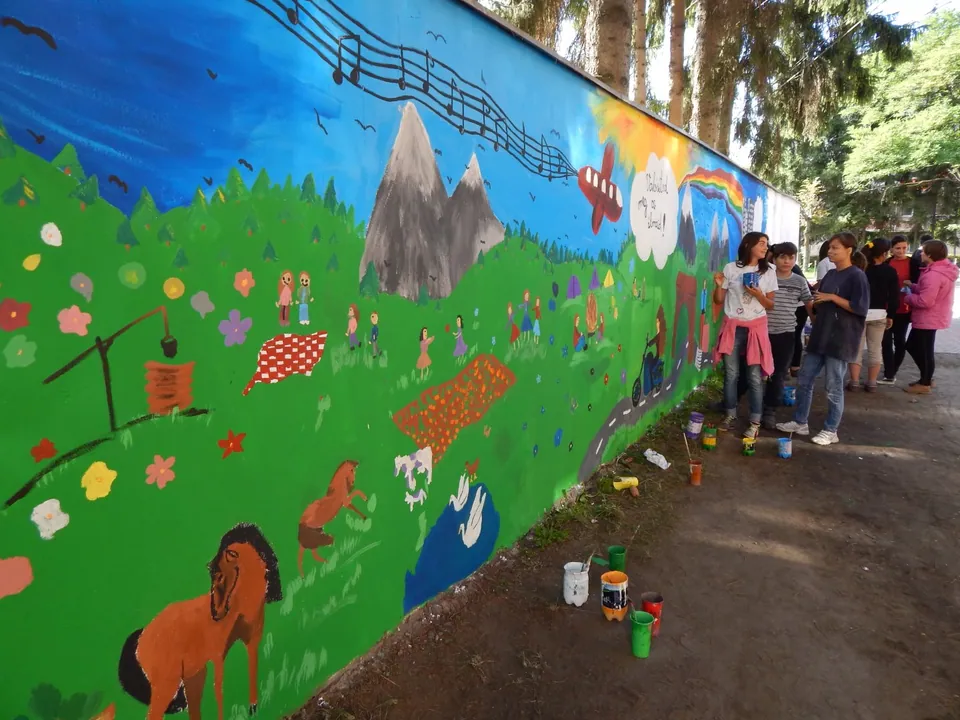
A large part of our programmes ended with a shared outdoor mural, which became a visual expression of the thoughts and shared messages that emerged during the group work.

Mural Painting at Babeș–Bolyai University

Date: 2026, Április Location: Babeș–Bolyai Tudományegyetem, Kolozsvár Participants: Master's students in Mental Health and Counselling Programme lead: Dr. Berszán Lídia, Kolumbán Rita, Kokoly Andrea

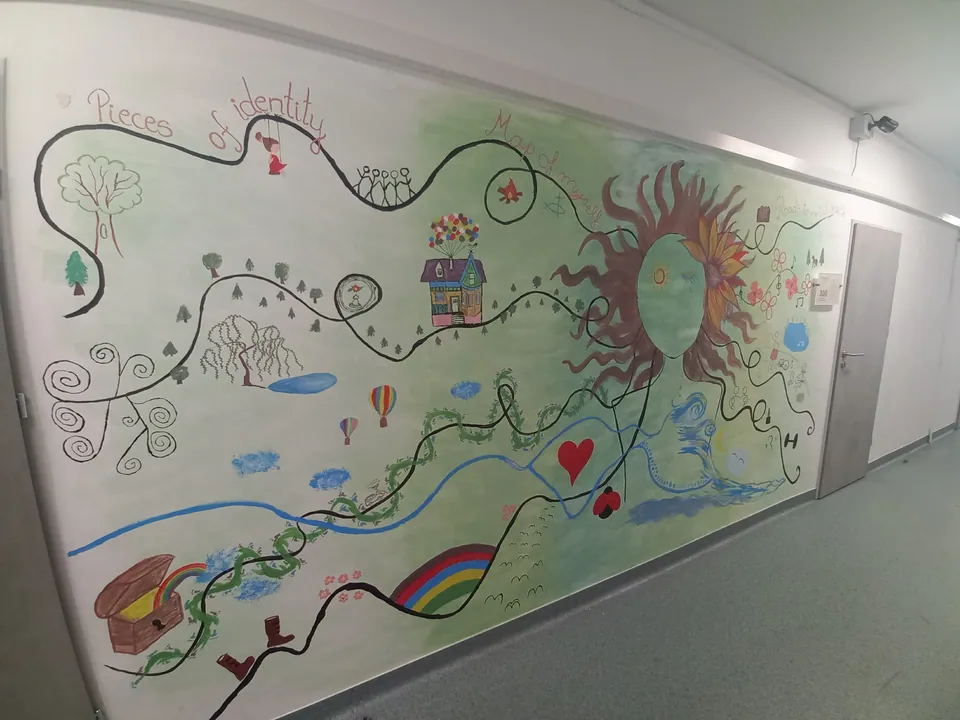
What would a map of our mental health look like? What could truly capture the paths, the stopping points and the inner resources along which we move through our everyday lives?

In April 2026, the Master's students in Mental Health and Counselling at the Faculty of Sociology and Social Work of Babeș–Bolyai University (BBTE) set out to find answers to these questions. Over an intensive, two-day process, the students could experience self-expression through creative work not only in theory, but also in the language of art and creation.

The professional workshop and the shared creative work came about through the collaboration and coordination of three dedicated professionals: dr. Berszán Lídia, university associate professor; Kolumbán Rita, mental health specialist; and Kokoly Andrea, a former mental health student, who accompanied the students on this inner journey.

From the contours of inner landscapes to a shared canvas

The process began with a reflective workshop. The students first reflected individually on what their own mental well-being looks like, what inner landscapes they walk through, where the safe havens and the harder stretches of road lie in their lives. They drew their own personal paths and inner maps.

In the second step, the many individual life experiences, lived moments and reflections came together: the students blended their diverse experiences into a single, vast, shared work of art. The joy of painting together and the shared search for colours and forms forged the team into a real community experience.

A small piece of the soul in the corridor

The fruit of this shared thinking and of the brushstrokes did not stay within the walls of the classroom. The colourful and eloquent painting now adorns the corridor of the Social Work Department at BBTE.

This map is not merely an aesthetic decoration, but a daily reminder for everyone who passes by it: our mental health is a continuously evolving, shared journey in which everything has its place — the rough roads and the soothing oases alike.

For the organisers and the participants alike, these two days were a tremendous joy, showing how wonderfully the mental health perspective and the art therapy approach can make visible and tangible even the most hidden corners of the soul.

We thank the Master's students for their openness, the deep conversations and the creative energy with which they filled the canvas and the university corridor!

The S/spirit Exhibition

Date: 2025 Location: KÖZ. közösségi tér Participants: Participants of the programme series Programme lead: Kolumbán Rita, Portik Noémi Klarissza nővér

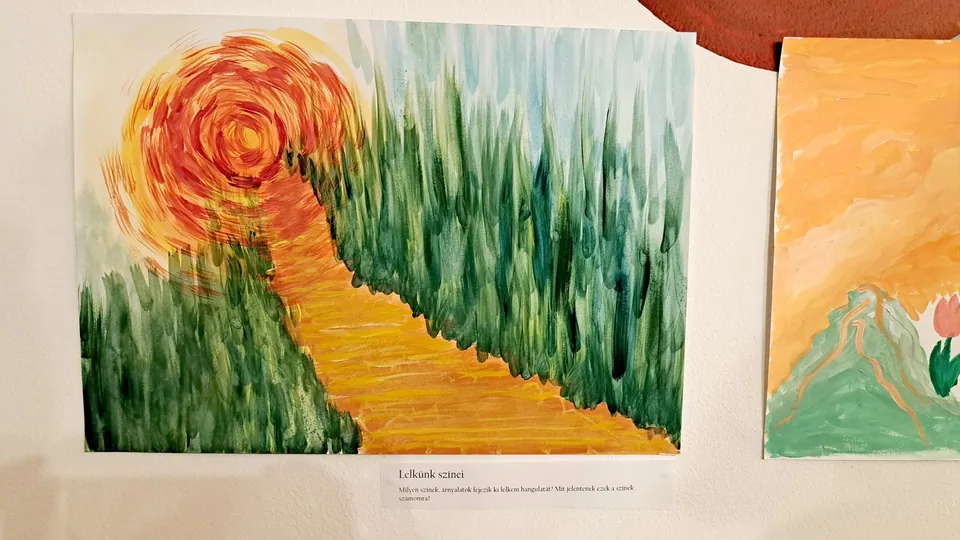
A special exhibition gave us a glimpse into the fruits of a year-long, quiet yet all the more profound inner work. The S/spirit Exhibition opened its doors as the festive and fitting close of our mental health programme series titled "Creation Attuned to the S/spirit".

Behind the exhibition lies an entire year, during which the participants met month after month at the day centre of the Franciscan sisters, in the Nardini dining hall. The sessions were led by Kolumbán Rita, mental health specialist, and Sister Portik Noémi Klarissza, a Franciscan nun, from whose shared idea and spirit this much-needed initiative was born.

What was the S/spirit Exhibition about?

By organising the exhibition we wanted to achieve a twofold, yet interwoven goal, bringing visitors closer to the art therapy and mental health perspective:

The creative power of ordinary people — we wanted to show the world that the ability to create is not the privilege of professional artists. We all carry creative ideas within us. Given a supportive environment and trust, people from the most diverse, ordinary backgrounds are also capable of creating something captivating, genuine and beautiful.

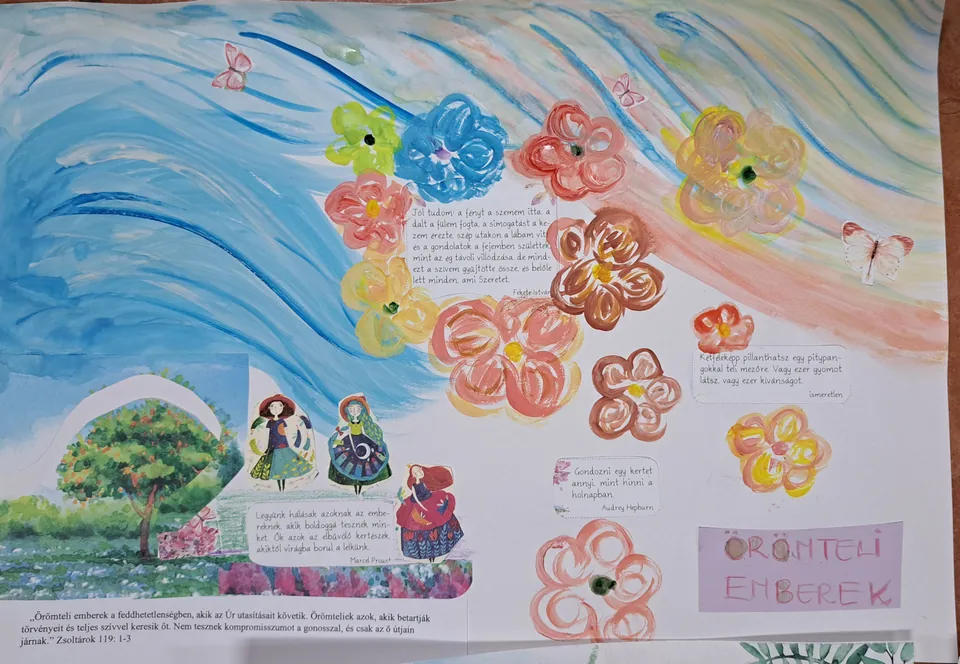
A glimpse into the mental health creative workshop — we wanted to lift the veil on how a self-discovery-focused session actually unfolds. The exhibition showed how paint, paper or collage become the non-verbal language of the soul — a tool that helps express what words can no longer convey.

"The goal was not aesthetic perfection, but the showing of inner feelings."

More than 50 works, more than 50 life stories

Within the walls of the KÖZ. community space, visitors could admire more than 50 unique works. These pieces faithfully followed the rhythm of the calendar and the liturgical year that the group had journeyed through over the course of the year.

Behind every exhibited piece stood the deeply lived feeling, the personal life experience and the intimate experience of God of one particular person. Visitors thus did not merely look at the works, but could gain a glimpse into intimate moments of human destinies and of encounters with the Creator.

We are grateful to the KÖZ. community space for giving a home to this special exhibition, to the creators for their courage in opening their souls to the public, and to every visitor who came to us with an open heart!

Creation Attuned to the S/spirit

Date: 2023 Location: Nardini – ferences nővérek napközi otthona Participants: Participants of the programme series Programme lead: Kolumbán Rita, Portik Noémi Klarissza nővér

A year-long, uplifting journey came to a close recently. In 2023 we launched our programme series titled "Creation Attuned to the S/spirit", which offered inspiration and a supportive environment to the participants month after month.

The initiative was born from the shared vision of Kolumbán Rita, mental health specialist, and Sister Portik Noémi Klarissza. Our aim was to create a creation-focused space with a mental health perspective, where we can turn toward ourselves and the Creator through the tools of art.

We found a home in the Nardini

The monthly meetings were hosted by the day centre of the Franciscan sisters, the Nardini dining hall. This space did not merely serve as a venue, but became a true communal creative space, where, leaving behind the noise of everyday life, everyone could arrive at their own inner stillness.

In rhythm with the liturgical and the calendar year

We deliberately wove the themes of the sessions onto the rhythm of the calendar and the liturgical year, thus helping a deeper experience of the feasts and seasons: in December the Christmas light and the mystery of waiting guided us; in January the inner work of starting anew, of clean slates and of planning took centre stage; in February we focused on experiencing joy, taking stock of our own, personal sources of joy; and in March, attuned to Lent, we turned toward the harder feelings — the participants took their own sorrows and losses as the starting point of their works, giving room for healing.

"Creation is not about perfection, but about making visible what is inside."

More than 50 works — 50 unique stories

Over the course of the year, more than 50 unique works were created. These objects, images and forms, however, are far more than mere creative works: behind each one lie deep, lived individual feelings, personal life experiences and intimate experiences of God.

Through working together we could experience that, while shaping lines, colours and materials, the soul too is shaped. We are grateful to everyone who walked this path with us and shared their feelings and experiences with us!

Women in Focus

Date: 2022, Augusztus Location: Gyergyószentmiklós Participants: Adult women Programme lead: Kolumbán Rita

In the Women in Focus self-discovery group, themes such as our self-portrait and our life path came under the magnifying glass, where we encountered many sustaining and at times also hindering factors. At the same time, we also talked about the value systems that form the foundation of our lives.

Drawing inspiration from the works created during the group work, we formulated messages important to us, which we shared with the town in the form of a mural — yet somehow, above all, it is the Women we are speaking to with it.

What do we see on the wall? As the central element of the wall, we see a woman looking into a mirror. A woman who looks into the mirror with contentment, day after day. In the mirror there is no face, only a message: "I love myself". This is our message! As women, let us dare to look into the mirror in such a way that, every single time, we can say: "I love myself!"

On the right side of the wall the woman's hair ripples out at length, and on the left her dress does the same. Her strands of hair and her dress conceal elements that are important and defining for us in womanhood. They also encompass the most important roles of being a woman. The woman appears as a playing little girl. The woman as a grandmother. The woman as a partner. The woman is present as a learner, forever longing to grow. The woman who is in a constant struggle with time. The working woman, and the woman who passes life on.

These elements all connect to the woman at the centre and convey: in any situation or role, as women may we be able to turn with love, first and foremost, toward ourselves.

The dress of the woman at the centre is adorned by a tender green tree of life, highlighting that in our roots we carry the patterns (both good and bad) of our ancestors, that we try to stand with a strong trunk in everyday life, and that with the fragility of little leaves, forever renewing ourselves, we proclaim the will to live and the beauty of life

I really loved the whole process. Honestly, I still can't believe I could be part of something this cool. As I already said during our meetings, I felt that I had a very great need for all of this — simply to be able to create something, or to be occupied with something that feels good and that helps me switch off. Before that I hadn't really had any me-time for weeks, and I longed specifically for some kind of creative activity too. During the weekly tasks I felt as if time stood still.B.V.E- participant

Creating a Vision with the Gyergyó Association of People with Mobility Disabilities

Date: 2021, Augusztus Location: Gyergyószentmiklós Participants: Adults with mobility disabilities Programme lead: Kolumbán Rita

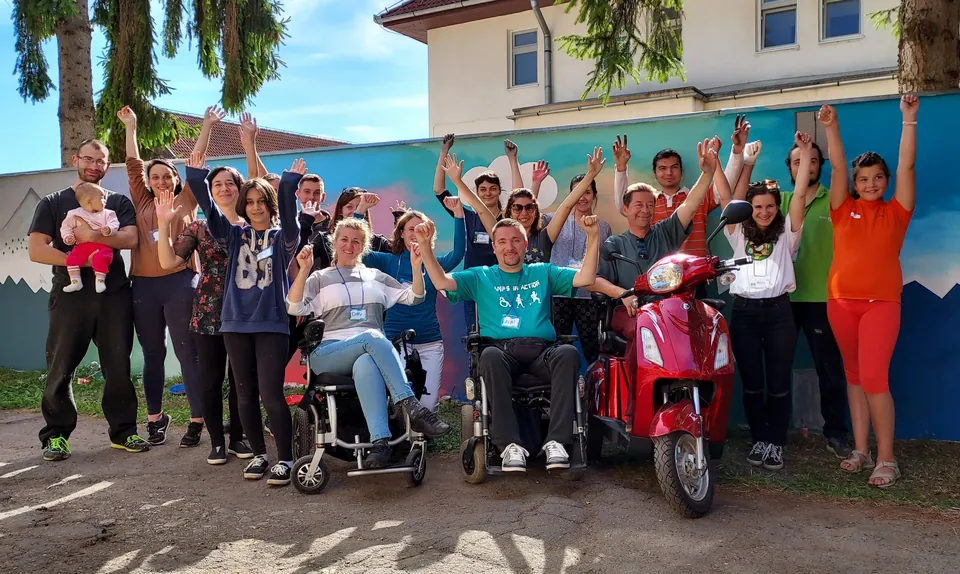
The Fessünk Álmokat programme has now completed its sixth action. This year, the members of the Gyergyó Association of People with Mobility Disabilities dreamed up a positive future. With the help of volunteers, they painted the dreamed-up design onto the wall of the alley next to the City Hospital in Gyergyószentmiklós. Five people took part in designing the wall, in the company of their carers. Fifteen volunteers assisted with the mural painting. During the design process, it was crucial that the message going up on the wall be positively charged and truly a goal worth attaining. During the planning, the main theme for the group was the obstacles they currently face. They drew attention to such simple things as the difficulties of an everyday errand in a wheelchair, or an ordinary shopping trip, etc. This too went up onto the final wall. In the end, the design depicts a future in which there is no difference between able-bodied people and people in wheelchairs, where getting around is manageable and they meet with less prejudice.

So what do we see on the wall?

Two "worlds" appear on the wall, separated from each other by a sharp line. In one, scenes unfold before us that speak of exclusion, rejection and helplessness. We see a balance scale where the tray holding the able-bodied people weighs more; we see a building where the high staircase makes it impossible for people with mobility disabilities to get in. Rejecting hands, figures turning their backs appear. The background, too, tries to signal that this is a hard, dark world. For many people with mobility disabilities, this can also be an ordinary weekday. But let us tell a little about the other part of the wall too. This is a kind of dream, an ideal world. We see a meadow of wildflowers where everyone feels equally well. A properly built ramp through which even an everyday errand becomes accessible to everyone, happy families, acceptance.

The two parts of the wall are connected by bridges — there are rickety and well-kept bridges, as well as a lift for easier crossing. These bridges symbolise change. The positive change we wish for ourselves. Seeing the person behind their limitations. This is one of the wall's main messages: see the person. The passage between the worlds runs in both directions; we ourselves can decide which way we set off next. We trust that the wall has an affirming quality for all those who, walking through the alley, look at it and read its message.

"I suspected that this would be an excellent opportunity in several respects for the local people with mobility disabilities, but in my view the result exceeded all our expectations: it not only gave us new experiences, new connections, a useful programme and the joy of creation, but this whole programme was also good for making ourselves known, for conveying important messages, and for finally leaving behind some important, striking (hopefully long-lasting) "mark" in our town." Kozma Albert – Association of People with Mobility Disabilities

"Personally, I had a really good time. I liked the Sunday more, because by then I already knew the folks, I was starting to remember everyone's name, whom I could go to if I had a question about a particular drawing. I'm satisfied with the result too; I now walk past the alley with a different heart, since I know that my work is in it as well. I especially liked that we worked with people with mobility disabilities — I have always valued them and can look up to them, that they are not depressed, but on the contrary, despite many difficulties, they are here, active, full of life. When the programme ended, I left with the feeling of coming home from a summer camp :)) I hope I'll have the chance to work with this team again" Köllő Emőke- volunteer

A Positive Vision — the Őszi Rózsák Elderly Club

Date: 2020, Augusztus Location: Gyergyószentmiklós Participants: The elderly Programme lead: Kolumbán Rita, Tankó Emőke, Dániel Botond

The entire design of the wall was conceived and dreamed up by the members of the Őszirózsák Elderly Club during the two-day workshop. The painting of the wall was undertaken by volunteers, with the aim of rendering precisely the design that the elderly had drawn.

During the workshop, the elderly drew their life paths, highlighting the moments they like to remember. Starting from these positive events, they began to design the wall, depicting the dreams they would like to attain. Each of the elements appearing on the wall carries its own meaning.

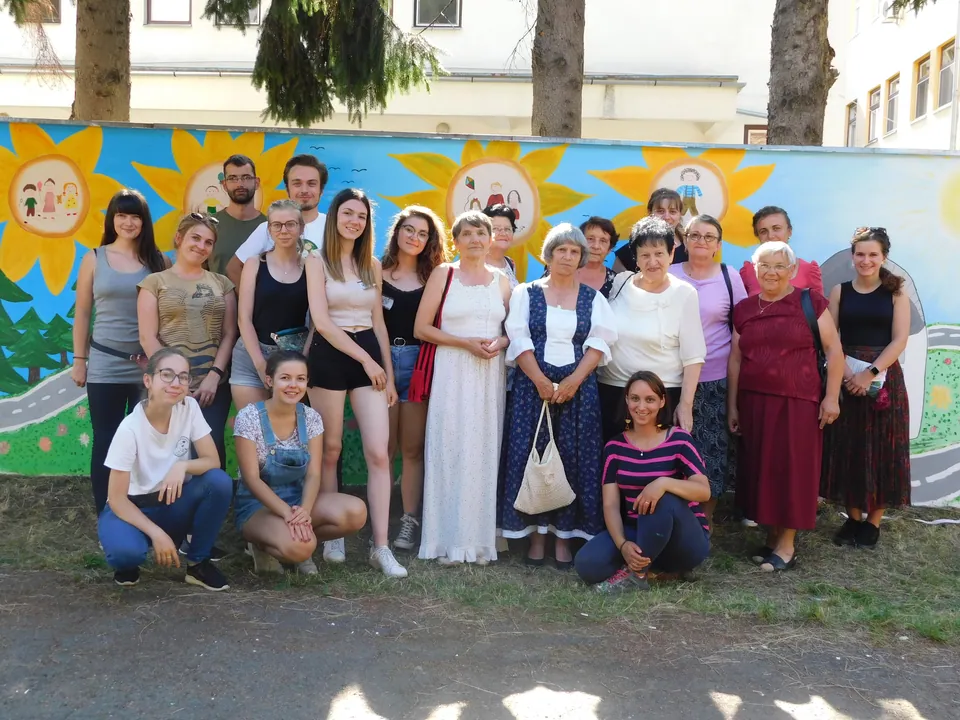
At the centre appears the church they all attend. Wherever they set out, they always set out from there and return there. The church is surrounded by branching roads, which means for us that, although they walked different paths throughout their lives, they nonetheless found one another at the elderly club and came to share experiences and goals. The bus travelling along the road symbolises the many trips and experiences they would like to share together in the years to come. Large sunflowers appear on the wall; these flowers represent their positive outlook on life, their attitude. Whatever difficulty they met over the course of their lives, they always turned toward the light and always saw the positive things in what was happening. In the centres of the sunflowers, children appear, representing that, after all, the greatest light in their lives is the presence of their grandchildren.

The violin appearing on the wall represents the cheerfulness and the desire to celebrate that characterise the elderly club. The inscription "helping hands" is a reference to the charitable spirit that has characterised the club ever since its founding. It is not a rare event for them to organise collections for those in need, delivering the support to the right place in person themselves.

The countless flowers on the wall are all asters. The aster is the herald of autumn, the flower that gives the elderly club its name. It blooms when the days are already growing shorter, when the approach of autumn's arrival can already be felt. This flower also symbolises the elderly who dreamed up the wall. Although they have already stepped into old age, there is still the possibility of flourishing — of blossoming and lighting up everyone's life.

At the wall's inauguration ceremony, every volunteer received a single aster as a gift. I think that these flowers, beyond being beautiful, also gave the young volunteers a rather great task: to live our lives already now in such a way that, when we grow old, we may carry on the wisdom characteristic of the elderly, the beauty of the aster, and that positive will to live which we learned from the Őszirózsák Elderly Club over the course of a few days.

"These two days far exceeded my expectations. I loved every minute of them and I'm so glad I got to work together with such great people. It was so good to see the joy on the ladies' faces; I'm happy that I could be part of all this. 😊🤍" Beáta- volunteer

"I had a really good time too! I was enriched by so many things over the two days. I thought as much as I hadn't in a long time, and in many respects it was constructive. And yet we 'only' painted... Thank you so much from me too." Brigitta- volunteer

Onward to Self-Discovery!

Date: 2020, Március-Május Location: Online Programme lead: Kolumbán Rita, Tankó Emőke

The Onward to Self-Discovery! Project is an online initiative. Over the course of the six-week programme, each week we shared self-discovery exercises that require simple tools found around the household. The exercises touch on several topics, such as clarifying the roles we live out, our resources, our inner worries, and the image we form of ourselves.

In the photos you can see the prompt connected to the "my roles" collage work

Families' Vision of the Future

Date: 2019, Július Location: Gyergyószentmiklós Participants: Families, parents with their children Programme lead: Fodor Rita, Tankó Emőke

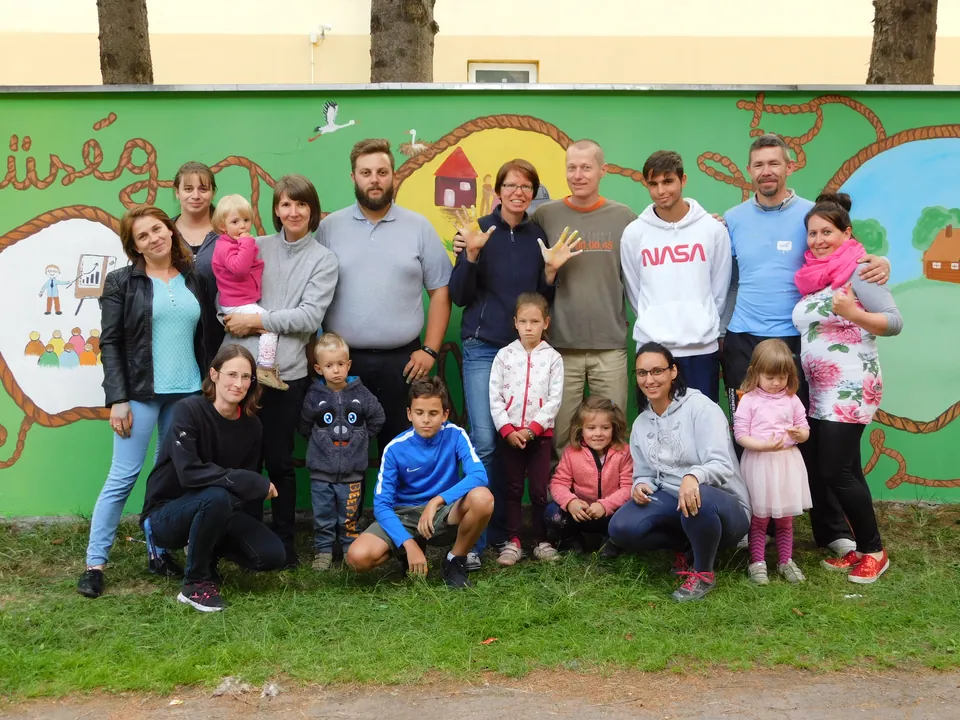
The alley filled with children and adults at the 2019 Fessünk Álmokat Programme. The aim was to articulate and depict families' vision of the future. In the group work, 5 families took part — 7 adults and 9 children in total.

The challenge of the group work was for children and parents to work along shared exercises during the workshops and to formulate dreams. For the children, the dreams and goals that took shape once again wove themselves around the question "what will I be when I grow up?" The photographer, the footballer and the "when I grow up I'll have a horse, a garden…etc." dreams also appeared.

The group work was woven through with the balanced relationship between children and parents. A lovely scene of the exercise was when, in the task titled Face Mosaic, a father and his son — working independently of each other, in separate spaces — composed their portraits with similar symbols, and in the end looked in surprise at the resemblance.

new paragraph textIn the adults' group, the plans for the future took shape along deeper lines of thought. The vision that moved the whole group is to see their children grow up and to experience what it feels like to become a grandparent. Another characteristic vision is to live in closeness to nature: "let us have a little house with a big garden". These are the two main pillars onto which we pinned other important plans, such as professional development or community development. Alongside the individual vision, the need for positive community change continually appeared. The relationship between the "I" and the "we" was significant in the group. This does not appear in the work of previous years. There, it is mostly individual development that is in the foreground. For the participating adults, development at the community level — working together toward this as a goal — was a strong motif.

In creating the design of the wall, great importance was placed on those keywords that we thought were absolutely necessary in order to attain the dreams we had articulated. The most frequently appearing among them: perseverance, faith, a partner, responsibility, trust, love, openness, learning, strength, commitment. Starting from these, the final design of the wall was born, with a thread running through it, symbolising that everything is connected to everything else, part of a network.

The wall follows a story, at the first point of which personal development appears, portrayed with symbols. This is followed by two rings, symbolising that committing to someone is a step that opens up an entirely new path before us. For the group, getting married was a life-changing, momentum-giving step. Woven into the net are the children's dreams, and the Bible, as a central and important resource in everyday life. In the middle, as a central element, closeness to nature appears, followed by a clock, which symbolises managing time and using it well. At the end of the wall appears the symbol of lifelong learning, and then the foremost goal: the extended family, where grandparents, children and grandchildren are together. One part of the wall preserves the work of the little children, and only with this is it complete, conveying the true atmosphere of families with small children.

Awareness-Raising Programme during the Kolozsvár Hungarian Days

Date: 2018, Augusztus Location: Kolozsvár Participants: Young people living with disabilities Programme lead: dr. Berszán Lidia, Fodor Rita

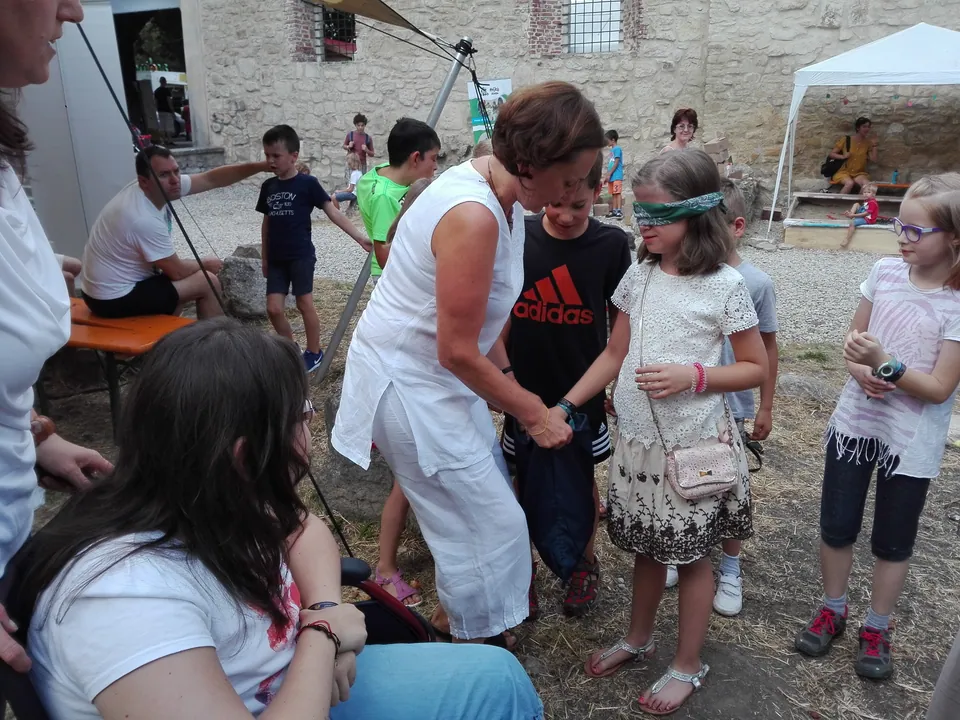
During the programme, young people living with disabilities painted together with their able-bodied peers. The aim of the programme was awareness-raising through firsthand experience. The participants could experience what it feels like to paint with closed eyes, with the mouth, standing with one's back to the canvas. The braver volunteers could also try painting with their feet. It was a day full of colours, laughter and a good deal of paint.

Awareness-Raising Programme during the Kolozsvár Hungarian Days

Fessünk Álmokat — Young Adults' Vision of the Future

Date: 2018, Augusztus Location: Gyergyószentmiklós Participants: Young adults Programme lead: Fodor Rita

During the workshops, we attuned to one another through small- and large-group self-discovery exercises, planning our future and, through it, the wall. Dreams, plans and vision were the theme, as in previous years, and as it turned out, these visions are very much shared within the team.

The key question of young adulthood is "where is my place in the world?". This question, and the challenges, joys and desires connected to it, became the main building blocks of the group work and of the wall. Through the teamwork, the message and the task of young adulthood came to the fore. Finding the most fitting work and field is at least as great a challenge as building a good relationship. Around these two cornerstones the other themes — which also come to life on the wall — are built: successful development in one's individual and private life, and an independent livelihood as a strong motif and goal. Here, a profession appeared less often as the ultimate goal. The vision was characterised far more by qualities and states of life. These connect to various fields of expertise, yet do not appear as the ultimate goal.

Through the group work we could see more mature visions of the future. Attaining the goals is determined by the energy put into them, the work, and the burdens these carry. During the task, we searched for the answer to the question "how do I find myself within my profession and my place in society?" We haven't fully found the answer yet, but we did formulate a path, which a little protagonist walks all the way through together with us

On the wall a comic-strip-like story appears, whose protagonist is a little puzzle piece. He alone carries every member of the team within himself. In the first picture, little Puzzli introduces himself and sets off on the rough road that leads him into the world of adults. His first big step and decision is leaving the parental home. It depicts the participants' process of separation, the period when, leaving the nest, they set off to try their luck and to study in another town. Here, through a few pictures, we see the university years, from the easy-going evenings, through the exam period that arrives like a storm, all the way to successfully earning a degree. Only after this does our little protagonist become truly an adult (or does he?); the following series of pictures depicts the questions of where to go, what to do. This is the period of uncertainty, of job-hunting. The search for a partner appears, together with the failed relationships, which is then followed by a fulfilling relationship and then family life. Throughout, this is woven through with continuous learning and growth. And so our protagonist arrives into adult life, where he finds his place and fits into the great whole. He is surrounded by many other puzzle pieces, each of which depicts one of the people who painted the wall. Together with little Puzzli, for us too the arrival is the foremost goal: arriving into an adult life that we dreamed up for ourselves.

The wall's story personifies most twenty-somethings who struggle with similar difficulties. And its message is the possibility of a positive, successful and responsible coming-of-age, despite the difficulties.

"I was particularly glad that — although the programme is built around dreams — we could also map out our past successes through the tasks. I feel that facing how much we have already achieved makes us more capable of setting out, more confidently and with greater self-assurance, to make our dreams come true. The painting flew me completely back to my childhood, since that was the last time I held a brush; it was a very positive experience to take this up again, to gather ideas about the colours and the placement, and to coordinate them. The other thing that was a very positive experience for me is that through the painting I can say of myself that, this young, I have already created something lasting. The atmosphere was wonderful; I felt that everyone found a common voice with the rest of the team. " Bálint Berna

"From the first moment of brainstorming to the last brushstroke, I loved being with the team. It is an incredible thing to see, and to be part of, the experience of a few people creating something beautiful together with super speed, smooth cooperation and, on top of that, good cheer. It is a joy to walk down the alley and see that I too did something for us, for the town, while in the meantime I came closer to myself, to others, and to others' dreams and my own." Dezső Renáta

TABLO Project — Autumn Dance

Date: 2017, November Location: Kolozsvár Participants: children with special needs Programme lead: Berszán Lídia, Fodor Rita

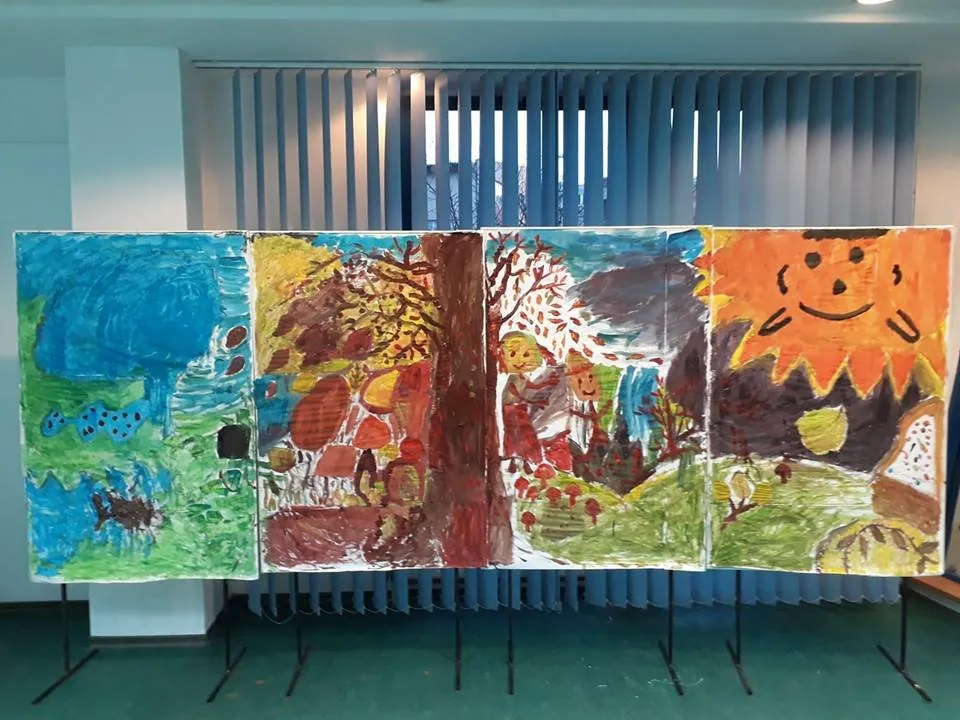
The aim of the TABLO project is to explore various alternative artistic tools used in helping work. Together with children with special needs, we presented the application of the "mural moral" method to the international team. The method and the mural painting sparked their interest. The autumn-dance theme encouraged the children to paint the movements and colours of autumn. Applying their own ideas and talking things through as a group, the shared painting took shape.

TABLO Project — Autumn Dance

Let's Paint More Dreams!

Date: 2017, Augusztus Location: Gyergyószentmiklós Participants: Adolescents Programme lead: Fodor Rita

Participants: young people aged 12–14

During the group work, money came up several times as a central external factor in making dreams come true, or as the element responsible for their failure to come true. The guided focus, however, is grounded in inner qualities. So perseverance and learning too became important building blocks of the work and shifted attention to the inner resources. It was from this that the visions of the future were born. Emphasising the inner resources is important in two respects. On the one hand, it tips the mood in a more positive direction; on the other, it brings to the fore resources whose recognition can make young people feel stronger and capable of influencing their future through their own attitude.

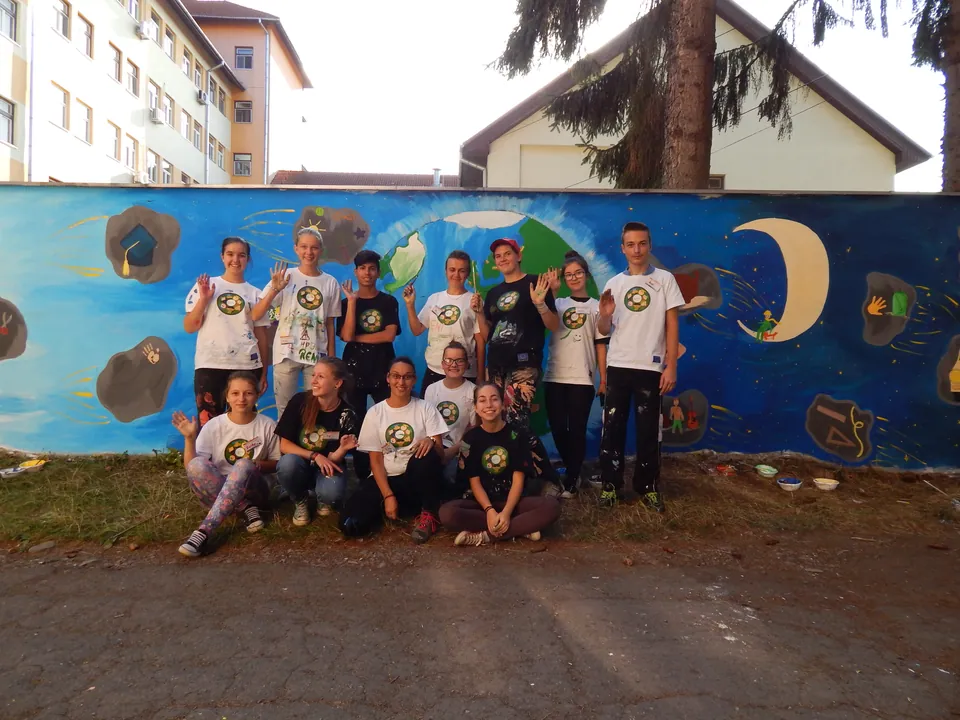
The central element of the finished wall is the Earth, where Gyergyószentmiklós appears in a prominent place. The background of the Earth changes from a completely black sky all the way to a pale-yellow Sun. The central message is that we are all under one sky, and so our realised dreams have their place here. These dreams arrive on Earth each on its own meteor. For every person, one realised goal arrives. Several meteors carry a vision shared by all participants, for example language learning, and starting a family as a more distant dream. The individual dreams are varied, mostly professions appearing. Compared to the previous age group, these dreams are more refined, although still distant and profession-oriented. During the planning here, the road that leads to fulfilment also appears before the participants, at least at the level of thought. Along with the road, the worries and the resources also find their place. As visions appear the maths teacher, the hairdresser, the tennis player. But there is also room as goals for one's own car, a cat, and playing a musical instrument.

On the wall appears the Little Prince sitting on the edge of the Moon, who symbolises the contrast between childlike curiosity and adult existence. The group's vision, too, oscillates between childlike curiosity and the experiences arriving from the world of adults.

Participant feedback

"I had no idea what to expect from the whole programme; rather, I had expectations of myself: to try to set goals for myself, because in front of me there was an empty wall. In the first half of the week I managed to get into the swing of it, and I was able to bring more and more to the surface from within myself that I hadn't even known about. As soon as the wall's design was ready, I knew it would be no small task to project the lines from a sheet of paper onto a wall. Just figuring out what we could offer the town already gave our brains a workout, but the painting part proved a greater challenge for me, since it isn't easy to draw a globe onto a two-metre-high wall — but I managed it. By the colouring part I was no longer nervous; I enjoyed doing it. It was good to see the curious pairs of eyes that kept stopping at the alley, asking questions. Looking at the finished work on the last day, I was filled with pride: I was proud of myself for bringing out my very best, and just as much of the team, that we could leave a mark on the town. I owe a lot to this programme: although I still can't give firm answers to the question "what is my dream?", the white wall would no longer be empty. Perhaps what has stayed with me the most out of the whole thing comes from the "inner resources" game: I "brought with me" the strength and the self-confidence to reach my goals, which I also put to use after the programme." Fórika Dóra

"When the wall was finished, there was a very, very great joy in me at what we had been capable of through willpower, teamwork and love. This one week was huge proof to me that I can achieve anything — it's only a question of will." Patka Henrietta

Let's Paint More Dreams!

Participation Instead of Pity

Date: 2016, December, 5. Önkéntesség világnapja Location: Kolozsvár Participants: children with special needs Programme lead: Dr. Berszán Lídia, Fodor Rita, Dr. Dániel Botond, Deák Enikő

The programme is an awareness-raising action whose aim is to encourage volunteering. On a busy street in Kolozsvár, we invited passers-by to contribute to solving social problems with their participation instead of their pity. Approximately 160 people took part in the programme: children, university students, residents of social institutions and lecturers from the social work department painted together. The end result was a painting in which the Earth is visible at the centre, surrounded by many different people who represented diversity.

Make Your Dreams Come True!

Date: 2016, Augusztus Location: Gyergyószentmiklós Participants: Children aged 11–15, permanent residents of the family-type children's home of the Ora International relief organisation. Programme lead: Fodor Rita, Dániel Botond

Make Your Dreams Come True! With this central message, the first wall was completed, painted by children aged 13–15. A distinctive feature of the group is that the participants are residents of a child welfare institution.

During the group work, articulating a positive, independent vision of the future posed a challenge and a difficulty for the participants. As long-term goals, they mostly portrayed professions inspired by someone dear to them, e.g. a hairdresser, a teacher, etc. So the workshop revolved around the central question "what will I be when I grow up?"

The wall blends the green hills of the countryside with the grey apartment blocks of the big city. Against the unified background, several different professions and lifestyles are represented. From the tattoo artist through the manicurist all the way to the kindergarten teacher, we see occupations appear. The farm woman who lives from growing vegetables and fruit appears, as does a successful athlete.

The painting of the dreams was done as a team. Everyone took part in colouring the background, but as the dreams went up onto the wall, everyone worked on the vision of the future they themselves had imagined. During the process, it was important to find a common point of connection that everyone could relate to. The participants chose a key sentence, which became the central element of the wall. Several ideas came up and were the subject of debate during the process. In the end the focus settled on two key sentences: "Dare to Dream!" and "Make Your Dreams Come True!" The debate was ended by the remark of one participant, who argued: everyone can dream, but not everyone can make it come true. And so the central message became Make Your Dreams Come True!

To close the process, everyone left a handprint on the wall, thereby signing the plans they had committed to.

Make Your Dreams Come True!

Colourful World!

Date: 2016, Április Location: Búzásbesenyő, Gondviselés Háza Participants: Students aged 13–18 (30 people) Programme lead: Kolumbán Rita, McAlister Magdolna

The mural-painting action titled "Colourful World!" took place in April 2016. Together with the students of the village school, we painted the inner concrete walls of the courtyard of the Gondviselés Háza care home in Búzásbesenyő. The aim was to nurture and maintain the relationship between the village and the care home.

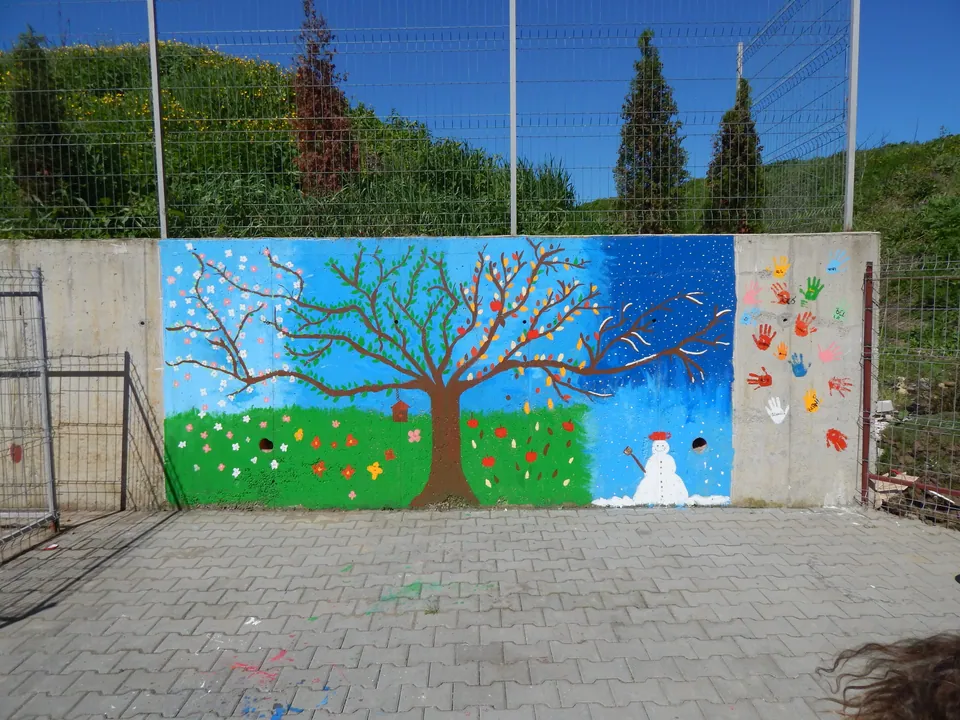
We chose the theme together with the head of the institution, taking into account the needs of those living in the care home as well, and so the main theme became closeness to nature. Two walls were completed with the collaboration of 30 children in total: the first depicts the four seasons, and the second is a landscape portraying mountains, hills and small villages. The first wall is 2 metres high and 5 metres long, the second 2 metres high and almost 10 metres long.

During the painting, it was the second part of the method — the painting itself — that came to the fore most, along with the practice of the tasks and skills connected to it. We carried out the preparatory work and the planning together with the management of the care home.

About the process of the painting and its effects, the head of the care home said the following:

"Mural painting? ....why don't we invite children from an art school instead? And if they really were to come from us, then we'd have to pick out the ones who draw well.... the teachers argued when I first raised this question — or rather this invitation — at the Dósa Dániel school in Búzásbesenyő. I tried to explain that here we don't need talent, but willpower. But that was only the first attempt, and to be honest even I didn't know what to expect. The programme got off to a slow start, but by the second day the courtyard of the Gondviselés Háza was already full of cheerful laughter, nimble hands, and — to the great delight of the elderly Residents — the grey walls began to grow ever more colourful. We hadn't seen any pictures yet, but the patches of colour took up more and more space, and by the weekend the work of several enthusiastic, persevering students was admired in great amazement not only by themselves, but by their teachers and fellow students too. For our Residents it was a special source of joy to see the cheerful team, and once everything had quieted down, several of them walked out, or asked us to wheel them a little closer to the drawings. The visitors' faces lit up as they came through the gate, and one of them said: I would gladly leave my elderly mother here, because this is a cheerful place....after all, even the walls speak of it. This week left its mark on the school's students and teachers too, and now they too believe that this is not a question of talent, but of will...do we want to create together? Do we want to create one big, unified picture made up of many small parts? It seems the students want to, their teachers support it, the elderly are waiting for it, and we are gathering our money to continue this work, since almost 30 metres of grey, bleak wall still await nimble hands and colourful paint...." (McAlister Magdolna, institution director)

I felt really good, you could say recharged, when I knew that we were painting on a wall that others could marvel at and show to their relatives, grandchildren, children :) .. I hope we'll have more painting like this together — and not only painting, but shared moments tooNémet Bernadett – participant

Contact

Have a question? Don't hesitate to reach out!